All past dinners

Archive / Historical record

Founder’s Day Dinner 2026

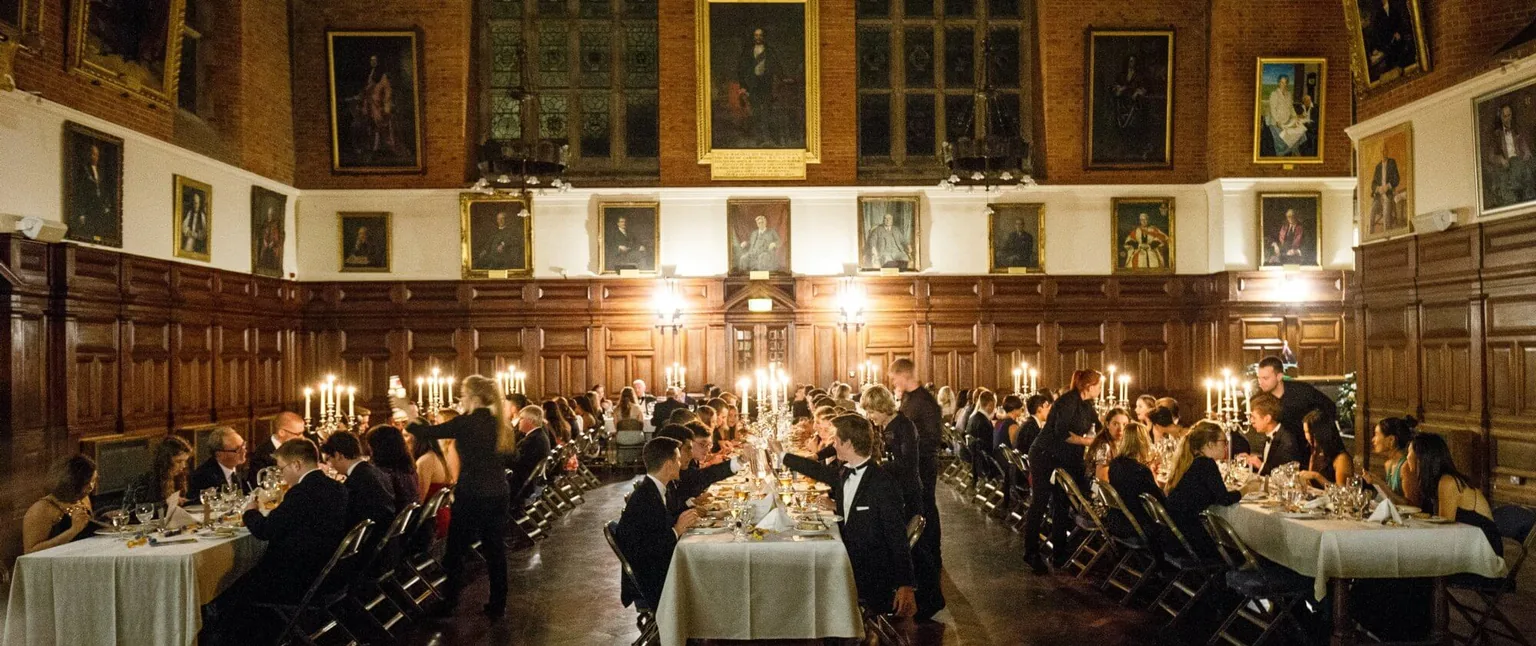
Two centuries of fellowship, remembered. Old Blues and friends came together at Christ’s Hospital for a landmark evening.

Saturday 31 October 2026 Christ’s Hospital, Horsham
Guests gathered at a Founder’s Day Dinner
A gathering shaped by generations
This page is a historical record of the 2026 dinner, not information about current arrangements.Bicentenary year
01

A record in pictures

Dinner photographs

Photographs from the dinner on 31 October 2026 are available in Gerald Sharp Photography’s gallery. View the collection and order photographs directly from the photographer.

View the dinner photographs (opens in a new tab)

Photography © Gerald Sharp Photography. The gallery opens on the photographer’s website.

02

Words remembered

Speeches from the dinner

Read the supplied speeches below. Roger Lane has approved the supplied transcript of his speech.

Final address

John Franklin

Guest of Honour · Head Master 2007–17

Founder’s Day Dinner Address

Read John Franklin’s address

Chief Steward, distinguished guests, Old Blues and friends of Christ’s Hospital, it is wonderful to be back this evening and to see so many familiar faces. Tonight is a very special occasion and marks the two hundredth anniversary of the CH Founder’s Day Dinners. The first recorded dinner was held in 1826 at the City of London Tavern, where 93 Old Blues gathered to celebrate the birthday of our royal Founder. Little did they realise that they were establishing a tradition that would continue largely unchanged for the next one hundred and fifty years.

But, change it did and in 1977 female Old Blues were admitted for the first time. Things moved quickly from there: in 1987 the dinner had its first female chairman and ten years later, it was chaired by Susan Mitchell, the first female Treasurer of Christ’s Hospital. Despite those changes, the purpose of these dinners has remained the same: to renew friendships, remember the school and give thanks for those who made it possible.

The last time that a Founder’s Day dinner was held at Horsham was 2010 and it seems entirely appropriate that we should be back here this evening to celebrate the bicentenary. What better place to reflect on a school that has changed so much, yet remained true to its original purpose?

Look around you. This remarkable hall holds so many reminders of CH’s rich history: Our royal founder over the pulpit, the Verrio celebrating our second royal charter on such an epic scale, the Hertford organ and, of course, past Treasurers staring across at the Heads and Head Mistresses.

But a building’s history is not only in its paintings and windows. It is also in the memories of the people who have used it.

Many of you will have memories of school meals in here. If, like me, you are past the first flush of youth, you may remember long tables and something vaguely resembling food ladled out from a steaming cauldron. Others will remember average food on plastic plates scraped into overflowing slop trolleys. More recent pupils will have enjoyed the luxury of quite good food on china crockery and a conveyor belt to whisk away their dirty plates. And of course, if you are a Hertford girl, your memories of school meals will be of a different dining hall altogether.

Still, no matter when or where you were a CH pupil, Christ’s Hospital offered you much more than just a basic education. It taught you resilience, initiative and how to live alongside others. It broadened your interests and your sense of what might be possible. It gave you friendships that will last a lifetime and a place in the wider community of Old Blues. Tonight’s dinner is a reminder of how strong those connections can be.

Of course, Old Blues are not the only people whose lives have been touched by CH. My wife Kim and I were fortunate indeed to have spent ten years here living and breathing Christ’s Hospital.

Running CH at that time was certainly not a job for the faint-hearted. It was all-consuming and no two days were ever the same. The school quickly became a central part of my life and looking back, it is the people and the friendships that remain with me. Without a doubt, CH was the most incredible experience of my forty-year teaching career and, like Kim, I feel very proud to have been part of this extraordinary institution.

Founder’s Day reminds us of our debt to our royal founder, but also to all those whose efforts and generosity turned Edward’s vision into reality. Across nearly five centuries, that commitment to CH has been renewed by generation after generation. Today, we inherit not simply a history to admire, but a purpose to carry forward.

In its time, CH has weathered plague, fire, war and financial hardship. It has moved from London to Horsham via Hertford and Ware and brought the Hertford girls back into the fold. Each of those changes has required hard decisions about what to preserve and what to do differently and that is never easy in a place where tradition means so much.

In some ways, it is like the old story of Grandpa’s axe: the handle has been replaced, the head has been replaced, but it is still Grandpa’s axe. CH, to its credit, has adapted and evolved constantly over the years, but it still retains its unique identity and its charitable purpose.

One thing that hasn’t changed in absolute terms is the Housey uniform. It sets CH apart from other schools, gives pupils a shared identity and puts everyone on an equal footing, whatever their background. I suspect it also provides its wearers with a shared sense of discomfort. This is an impressive achievement for an outfit based on the original Tudor uniform.

Partway through my time as Head, someone suggested asking the pupils whether they wanted to change the uniform. We had a fair idea of the answer, but had not anticipated quite how strongly they felt about retaining Housey. The message was unmistakable: change other things if you must, but leave the uniform alone.

While the school’s charitable purpose hasn’t changed over the years, the cost of providing a first class boarding education for nine hundred pupils certainly has. Last year, the school spent over £20 million on means-tested bursaries and I suspect it will spend even more this year. Financial pressures and the cost of maintaining the campus cannot be wished away. But, neither should they become the whole story. The reason for meeting these challenges is and must remain the transformative education they make possible.

That is why the generosity of Old Blues and other supporters matters so much. Behind every gift is the possibility of a young person discovering an interest, developing a talent or gaining the confidence to make their way in the world. We may never know how much our support touches the lives of each pupil, but we can still help to make those opportunities available to them.

A community such as this is sustained by many acts of generosity, some visible and others quietly given. And, support is not measured just in monetary terms. It is also the time you give as speakers, coaches, volunteers and stewards; the experience you share; and the connections you help pupils make beyond school. To everyone who has given or continues to give something back to CH, thank you.

As we celebrate two hundred years of these dinners, we are doing more than just looking back. We are renewing a connection between generations. This “school like no other” has changed, and will no doubt change further under the capable leadership of the current Head and Treasurer.

What we hope to pass on is the same belief in opportunity that brought us here tonight: that a young person’s future should not be limited by their starting point.

That is something worth preserving, worth supporting and, this evening, worth celebrating.

Thank you.

I would now ask you to stand and join me in the Housey toast:

The religious, royal and ancient foundation of Christ’s Hospital; may those prosper who love it and may God increase their number.

Approved transcript

Major General (Retd.) Roger Lane RM CBE

Response · Mid. B 1966–72

Founder’s Day Dinner speech

Read Roger Lane’s transcript

Headmaster, Chief Steward, Officers, Almoners, Governors, distinguished guests, ladies and gentlemen… and my nursemaid Crispin Southgate!

Wow! Coming back here brings back so many memories and I thought it appropriate to focus on just one word in the Housey Charge – “benefits” – not the kind of which the Prime Minister and Chancellor of the Exchequer so fondly speak but those which I gained here. I want to share with you some of those reflections, which I hope will resonate with you as well.

I remember walking in here 60 years ago. I had never been to a place where 800 people sat down at the same time to dine. I’d never seen a picture as big as this, and I’d never seen the largest unsupported roof in Northern Europe at the time. This was a statement of ambition. We can do something of monumental proportions; we can do it at scale and we will not be limited by our self-beliefs. And that set the pattern for what I learned.

Whilst the Guest of Honour spoke about our distinctive uniform providing a common identity, for me it was not only that but something else as well: it was a great leveller. There was nobody wearing Gucci shoes or anything like that to say where you came from, who your parents were, as other schools had. No, we were all the same. Apart from those of us wearing an RMS badge or the most ridiculous way in which the Grecians used to wear their girdles, hovering just above their kneecaps, we were all the same.

So what did I learn from that? Substance trumps form. With all of us wearing the same uniform, we could not differentiate by appearance. So the differentiator was the human being wearing that uniform: what were their dreams; what were their aspirations; what interests might we share; and what might we explore and learn together. For somebody who went into a very people-focused service, the Royal Marines Commandos, that proved to be extremely helpful to me.

It also meant I learned a lot about people who had completely different interests to me. I do not have a semi-quaver of musical talent in my body but coming from the Chapel tonight, I was reminded of Simon Jolly, who was a phenomenal music scholar, mastering the multi-register organ in Chapel, accompanied by the choir, singing English choral music. It was an absolute knockout. It was fantastic. Or take Andrew Wickes, our Chief Thespian, whose dazzling direction of the school plays was magnificent. And I like to think that part of his legacy lay in the growing realization of the importance of the performing arts, resulting in a decision to build the theatre that you enjoy today, allowing them to flourish.

So let me turn to an area that was more familiar to me: the rugby field. Allow me to characterise some of the players in our 1st XV. Our Captain, John Whitworth, was the number 8, 6ft 3”, the Maro Itoje of our team. He could soar into the air, pluck the ball out of nowhere and hand it off to the scrum half. He could spiral kick a sodden, leather rugby ball 40 metres up the touch-line, much to the joy of the pack, spared a feisty encounter with a Dulwich or Whitgift pack. Or you could take Tim Pavitt, who was a very muscular centre, who used to crash through the opposition’s back line and leave them dangling on his legs like baubles on a felled Christmas tree. Or you take Ian Bartholomew, who was the hooker and had forearms like JCB buckets. He would burrow his way into that writhing mass of humanity which TV commentators eloquently call a ruck or a maul. He would deliver the ball to the scrum half as if it was a roast turkey on a platter. If you gave Wally Muir – the Flying Scotsman- the ball as a winger, he would soon dot the ball down.

So we had brilliant individual talent in the team but that wasn’t enough. What we needed was somebody with the ability to weld those talents into a cohesive team. And here we found good fortune in our coach Roger Wilson, a maths master, and Gerald Davies, a Welsh international and British and Irish Lion winger, who was also my deputy housemaster.

What they did was something quite unique in those days. They summoned us back from the summer holiday a week early. They took us to Climping on the coast. If the tide was up, we would run up and down the sand dunes relentlessly and as soon as the tide went down, they would mark out a pitch and then we’d go through the drills repeatedly. And what we learnt at the end of that week was that we were stronger, we were fitter, we were more cohesive and we had developed an intuitive feel as to how each of us was going to play. Unsurprisingly, we had a fantastic season, with 12 wins, one draw and one loss, if I recall correctly.

So what I learned from that was that the English dictionary is the only place where success comes before work. As a Royal Marines Commando, you must train hard to be prepared for the high-risk missions for which they are tasked. You also need to know how your buddies are going to operate and fight, if necessary, and what each expected of each other. This was learnt on the rugby field, here at CH.

“Substance trumps form” is what our uniforms taught me; “the dictionary is the only place where success comes before work” is what I learnt on the rugby field or tennis court. But the third thing I learnt was what I’d call learning to lead.

At CH there are lots of different opportunities to lead. It could be leading a section in the orchestra; it could be painting the flats for one of the plays; it could be serving as head of a table; it could be captain of a sport. It could also be a house captain.

But what made that learning opportunity quite unique at that stage of my life? It was the fact that we had a very safe, supportive environment. Because we made mistakes; we were always going to make mistakes. But what CH staff, our friends, family and colleagues did was help us to rebound, recover, refocus, and then go again. And again, that learning transferred into the key responsibility of being a commander in high-risk missions. The late Duke of Edinburgh once said that “Nothing was impossible for the Royal Marines”. If you flip that it becomes “Everything is possible in the Royal Marines”. That puts a very high level of responsibility on those of us who lead because of the expectations that it carries.

I’ve made loads of mistakes, and I learned more from my mistakes than from my successes. And what I’ve tried to do over the years is to share those with others, so they don’t make the same mistakes. Build a safe, supportive environment for others to grow. That’s learning to lead. And it doesn’t matter what the field is: seize the opportunities that are in front of you.

So that then leads to my final point, which is this: discovering one’s life purpose. In the commercial part of our world, we run a programme called Purposeful Teams, the idea being to connect Organisational purpose with Team and Individual purpose. That set me on a search for what was my life’s purpose. My life’s purpose is really very simple, and it’s this: to help others to fulfil their potential to make a positive contribution in their world, whatever that may be. Perhaps unconsciously, I think that life purpose began here because of the effect of being in CH and all the opportunities that it offers those who might otherwise be unable to access it.

So those values of kindness, compassion, humility and authenticity that I inherited from school have carried through into the rest of my life. And I hope that you will all discover your life purpose, particularly those of the younger generation here, because it is one of the most life-affirming things that you can do. It helps you make decisions. It makes you less worried about things, because you can always go back to that anchor. So be bold: search for it, find it, nourish it, and then set it free, and you will be free too.

So if I put all of those together — what did I learn. The first is the kindness that allowed people like myself to come to the school in the first place. I was one of four brothers who came here with an unbroken presence in the school from 1958 to 1975- 18 years. We were very, very fortunate indeed.

Secondly, shoot for the sky. That aspiration starts here, in this room. The ambition of the size and scale of the Verrio painting and the largest unsupported roof in northern Europe shouts ambition.

Third, we all make mistakes. Just put your hands up. Even when it’s really hard, you must stay authentic to yourself and those whom you lead.

So I’d just like to say thank you for everything this school gave me. I hope that at least one of those three things resonate with some of you. I hope all of them resonate with some of you. And for others, it might inspire you to search for your life’s purpose.

So thank you for the opportunity, Bryan, Chief Steward. For the record, my recollection of accepting this honour went something like this. I said “I think you need somebody with more gongs and a higher rank. I’m really busy; I don’t know whether I can make it but if you’re really stuck, I will do it.” Ten minutes later, the task was mine, so I am just guessing not that many others were contacted.

So thank you. Thank you for what the school has given me and my brothers. Thank you, everybody, for being here tonight, and let us take forward our responsibilities to nurture it so that others may have the same degree of opportunity as ourselves. Thank you. Thank you very much.

03

From the evening

Programme and service

The dinner programme and Chapel order of service are kept here alongside the speeches. These documents remain available to dinner attendees and organisers; the programme includes private guest information.

2026 Dinner Programme

The full seven-page programme, including the menu, guests of honour, diners, Stewards and dinner traditions.

2026 Founders’ Day Service

The order of service for the Chapel Service, including the hymns, readings, prayers and blessing.

Sign in with your dinner attendee or organiser account to open or download these documents.

Sign in to view the documents
Christ's Hospital school crest

Founder's Day Dinner

Old Blues of Christ's Hospital have gathered to dine on record since 1826 — and very likely before that — celebrating the birthday of King Edward VI and uniting generations of former pupils.

Navigation

Contact

For enquiries regarding the dinner, please contact the Stewards directly.

e

© 2026 Christ's Hospital Founder's Day Dinner. All rights reserved.

System Status